

Between 2011 and 2016 I managed one of the largest architecture projects in Central America. The interior designer outsourced its documentation to a remote team working outside the project's workflow. The drawings were in AutoCAD then, but the problem would be the same in Revit today: nobody on their side owned coordination or quality, so every gap landed on the designer's PM desk and on mine. Together with the hotel operator's approval cycles, those coordination gaps cost the project months. The tool changes. The risk is in the delivery model.
The most common risks of outsourcing BIM work
Most outsourcing models place individual modelers inside a vendor and leave supervision to you. Each risk below is what that setup produces, and how a dedicated, managed team removes it.
Inconsistent quality and standards
Freelance or staff-augmented modelers rarely work against your templates, naming conventions or LOD, so rework lands on your desk. In my experience, most rework does not come from bad modeling. It comes from a modeler who was never walked through the template. When a Project Leader runs QA/QC on every milestone deliverable against your standards, and a BIM Manager or BIM Coordinator checks it against your BIM Execution Plan, as in our quality is managed before it reaches you.
Weak communication
A vendor outside your workflow turns small questions into schedule risk and makes you the relay. Seamless integration, with one accountable lead on each side, puts every question in front of someone who can decide. Decisions arrive on time, at the key moments, and a misunderstanding does not end in rework or additional cost. Good BIM coordination depends on it.
Data security and IP exposure
Project files and design intent leave your firm. Role-based access in a shared CDE, plus clear agreements on confidentiality and ownership, keeps them protected. Whenever possible, the team works inside your environment, not on copies, so your files stay where they are.
Key person dependency
When project knowledge lives with one modeler, a departure becomes your problem. At Blend, every Blender (our professionals assigned to your project) works with a Project Manager, a BIM Manager and a BIM Coordinator who know your project and act as backup. If someone leaves, your project knowledge does not leave with them.
Vendor lock-in
If your standards, families and models only exist on the provider's side, switching providers or bringing work in house gets expensive. Documented standards, live access to your own models and agreed handover steps keep you free to choose. A good provider should make leaving easy. That is what makes staying a decision.
Hidden costs
The lowest hourly rate is rarely the lowest project cost. A few years ago a European architecture firm chose another provider over us on price. Two months later they came back and asked us to fix the models. We corrected them in three weeks, but it cost them more than doing it right from the start, and the result was not as good as it would have been with us involved from day one. Rework, review time and schedule slips never show up in the hourly rate.
Freelancers, staff augmentation, dedicated BIM teams or fixed-fee projects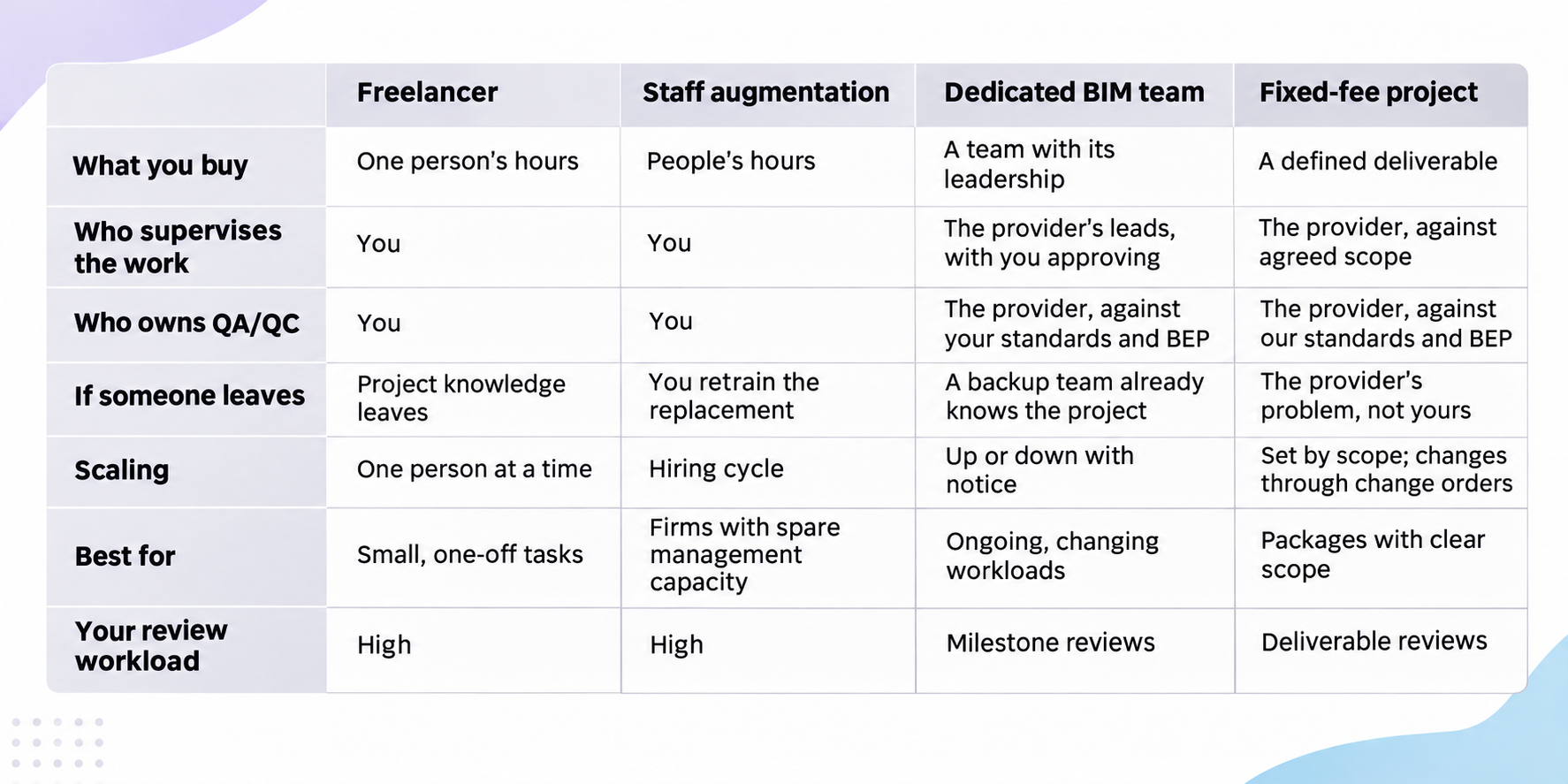
What you gain when it is managed well
Managed well, outsourcing gives you capacity you can scale without hiring, a team that knows your standards by the second project, and senior oversight on your drawings without senior payroll. At Blend, every Blender works with a Project Leader running QA/QC and a BIM Manager or Coordinator checking compliance with your BEP, so you add production without adding to your review workload. You can work with us as a dedicated BIM team that scales with your workload, or as a fixed-fee project with defined scope and deliverable.

Frequently asked questions
Is it safe to outsource BIM work outside the US?
Yes, if access, ownership and confidentiality are defined before any file is shared. Role-based CDE access, a signed NDA, clear model ownership and access removal at project close cover most of the risk.
What is the difference between staff augmentation and a dedicated BIM team?
With staff augmentation you get modelers and keep the supervision. With a dedicated BIM team the provider also supplies the leadership, QA/QC and BIM management, and you review at milestones.
How do I choose a BIM outsourcing company?
Ask who reviews the work before you see it, who backs up each modeler, how scope changes are handled and how you would leave. Our free checklist covers the 20 points to check.
Should I outsource BIM work hourly or at a fixed fee?
A dedicated BIM team fits ongoing workloads that change week to week. A fixed fee fits a defined package with clear scope. Either way, agree how scope changes are handled before work starts.
Capacity that feels like your own team
Good outsourcing should make your team feel bigger, not busier. When your workload
keeps moving, a dedicated BIM team moves with it. When the package is defined, a fixed fee project keeps scope, schedule and cost settled from day one. The BIM outsourcing risk checklist is a good way to see where your current setup stands. And if you would rather talk it through with people who have done this before, we would be glad to hear about your project.